
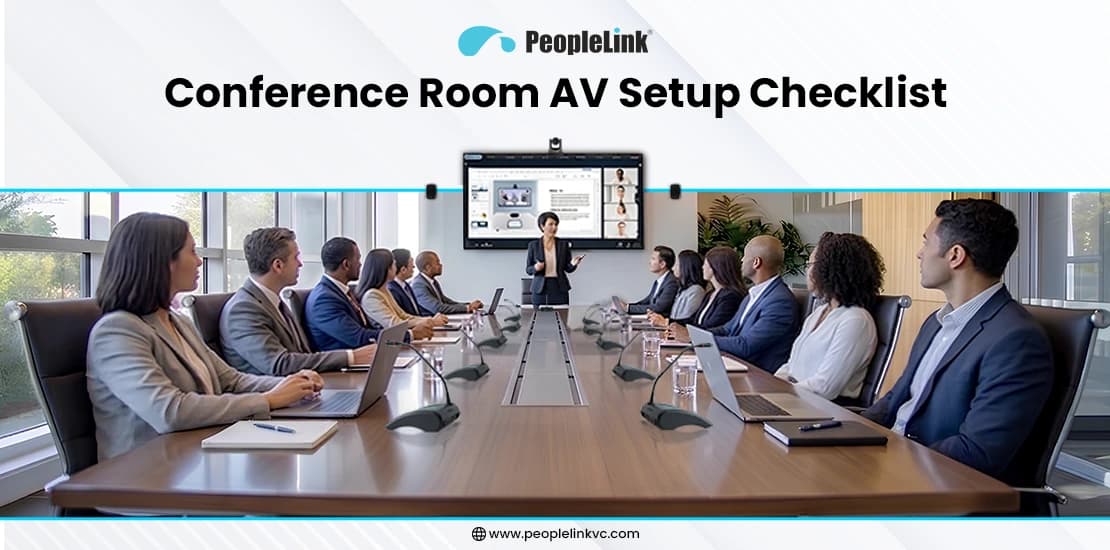
Remember when a conference room setup simply meant hanging a consumer flat-screen television on the wall, running a long HDMI cable across a mahogany table, and tossing a triangular speakerphone in the center? If a remote participant couldn’t hear, we just raised our voices. If the video froze or lagged, we toggled the camera on and off.
In 2026, those days are firmly behind us. The modern workplace operates on a permanent hybrid model. Corporate boards, IT professionals, and facilities managers are no longer just building physical meeting spaces; they are managing interactive, modern collaboration spaces. Today’s workforce demands frictionless collaboration where physical distance feels virtually invisible. A poorly designed meeting environment directly impacts organizational velocity, misaligns teams, and frustrates decision-makers.
This ultimate Conference Room AV Setup Checklist outlines how to architect a modern corporate workspace designed for maximum efficiency, seamless interoperability, and future-proof performance.
Why Conference Room AV Planning Matters in 2026
Workplace expectations have changed dramatically. In-office professionals routinely collaborate with distributed teams, international clients, and field operations. Meeting equality—the principle that every participant, whether sitting in the boardroom or joining from a home office, has an identical visual and auditory seat at the table—is the primary design metric for modern enterprise spaces.An ad-hoc approach to conference room AV setup often creates operational bottlenecks. If an executive wastes ten minutes fighting a complex control panel or correcting echo problems, meetings stall and productivity plummets. Standardizing your approach ensures that IT resources aren’t consumed by constant reactive support tickets, allowing your team to focus on strategic corporate infrastructure.
1. Assessing Room Requirements & Meeting Dynamics
Before selecting hardware, you must analyze the spatial dynamics and primary functions of the room. A standard design template cannot fit every physical space.- Huddle Rooms & Focus Spaces (2–5 occupants): These spaces require rapid, friction-free deployment. Content sharing and wide-angle visual fields are critical because participants sit close to the main display and camera.
- Medium Conference Rooms (6–12 occupants): These spaces require dedicated audio distribution, sophisticated camera tracking, and clean cable management solutions to accommodate balanced round-table discussions.
- Executive Boardrooms & Training Halls (12+ occupants): These complex environments necessitate multi-display configurations, advanced digital signal processing (DSP), multiple microphone arrays, and integrated control automation.
Determine the primary use case of the space: Is it designed for collaborative brainstorming, formal executive updates, or client-facing presentations? Identifying these core requirements avoids costly equipment over-specification or functional under-performance.
2. Essential AV Equipment Component Checklist
A high-performance video conferencing room setup relies on tightly integrated hardware subsystems. Each core component must be deliberately chosen to avoid system bottlenecks.High-Definition Enterprise Displays
Move beyond standard residential televisions. Commercial displays are engineered for continuous 16/7 or 24/7 duty cycles, feature anti-glare coatings, and offer high nit brightness levels to combat ambient office light. For medium spaces, a single 75-inch to 85-inch 4K commercial panel provides excellent readability. In executive boardrooms, consider a dual-display matrix (one panel dedicated to high-resolution content sharing, the other strictly displaying the remote participant video gallery) or an ultra-wide 21:9 aspect ratio display to support advanced layout interfaces.
PTZ & AI-Driven Cameras
Standard fixed lenses are insufficient for dynamic group collaborations. Modern systems require Pan-Tilt-Zoom (PTZ) optical systems or specialized multi-lens arrays. In wider or deeper rooms, a camera must possess optical zoom capabilities to capture individual faces clearly without pixelation. Integrated intelligent framing logic automatically adjusts the field of view based on active attendance, creating a balanced visual experience for remote viewers.
Expert Tip: Always mount your primary camera at eye level between or directly below your display panels. Placing a camera too high creates an unnatural downward viewing angle that detaches remote participants from natural eye contact.
Microphones, Soundbars, & Audio Processing
Audio quality dictates meeting success; remote participants will tolerate compressed video, but poor audio completely stalls collaboration. Modern designs utilize intelligent beamforming ceiling microphone arrays or sleek architectural tabletop modules that dynamically isolate human speech while actively filtering out ambient room noises, like HVAC hums or laptop keyboard clicks. Pair these with high-fidelity front-of-room soundbars or distributed in-ceiling speakers to guarantee uniform sound coverage across every seat.
Central Control Systems & Physical Connectivity
Minimize user friction by deploying intuitive touch-screen control panels at the table. These interfaces allow users to launch scheduled sessions with a single tap, adjust speaker volumes, and toggle camera presets. Ensure physical connectivity remains robust by providing tabletop access enclosures featuring HDMI, USB-C, and DisplayPort lines, allowing visiting presenters to connect immediately without hunting for missing dongles.
3. Network, Infrastructure, & Security Architecture
Even premium hardware will falter on a poorly optimized corporate network. A dependable integration plan requires strict infrastructure standards:- Dedicated AV VLANs: Segment all video conferencing traffic onto a separate Virtual Local Area Network (VLAN) to safeguard media streams from internal corporate data bottlenecks.
- Quality of Service (QoS) Rules: Configure network switches to prioritize real-time audio and video packets over general business data traffic, avoiding dropped frames and voice dropouts.
- Hardwired Gigabit Ethernet: Never rely on office Wi-Fi for primary room systems. Ensure the main computing unit, touch panels, and network-attached audio systems use shielded Cat6 cabling.
- Enterprise Device Security: Enforce 802.1X network authentication, ensure all system components operate on encrypted firmware, and routinely change admin access credentials.
4. The Transformation of AI-Powered Meeting Rooms
The defining shift in 2026 corporate technology is the rise of AI-powered meeting rooms. Artificial intelligence has moved beyond a marketing buzzword into an essential productivity driver. Modern systems utilize edge-computing processors to analyze environmental variables in real time.AI computer vision automatically tracks the active speaker, zooming in seamlessly when an in-room participant speaks, and widening smoothly when another team member joins the conversation. Advanced multi-stream technology separates individuals within a physical room into their own separate video tiles on screen, placing remote and in-person workers on an identical visual footing. On the audio side, machine-learning algorithms identify and remove non-human acoustic disturbances while automatically balancing the volume of quiet speakers against louder voices in the room.
5. Case Study: Advanced Institutional Integration in Action
Theory is best proven by execution. A premier example of these standards implemented at scale can be found in the video showcase: Advanced Conference Room Setup for Government | PeopleLink.
- Faced with the challenge of modernizing a massive, multi-seat executive layout for a Government Healthcare Institute in Bengaluru, a robust architectural approach was required. The room parameters presented complex acoustical and sight-line demands that a typical single-device setup could never resolve.
To tackle this challenge, a tailored multi-subsystem integration was deployed:
- Visual Dynamics: Centralized high-performance interactive displays were coupled with a premier Elite 4K Premium Series 20x PTZ camera. The 20x optical zoom dynamically bridges the physical expanse of the deep U-shaped table layout, ensuring distant speakers face no visual pixelation.
- Audio Architecture: A structured Digital Conference System was deployed across every desk position. By pairing dedicated goose-neck units with UHF Wireless Handheld Microphones and strategic Wall Mount Speakers, the design completely mitigates reverberation while enforcing standard acoustic equilibrium across all seats.
- Central Control: An interactive ePodium (Digital Podium) stands at the front of the room, linking directly to a centralized Audio-Video Control System rack. This gives presenters real-time command over media elements, lighting presets, and platform routing from a singular interface.
This real-world installation underscores how deliberate physical layout, acoustic mapping, and network-grade AV hardware combine to form an uncompromised enterprise communications environment.
🏢 Replicate This Success in Your Enterprise
Want to transform your high-stakes meeting spaces into high-performance collaboration hubs just like this government project? Let our engineers build your blueprint.
6. Optimization of Room Acoustics & Lighting
Premium hardware cannot fully compensate for a room with terrible environmental acoustics or blinding architectural lighting.- Acoustic Management: Modern office design heavily utilizes glass walls, polished concrete, and hard surfaces. These materials act as acoustic mirrors, creating distracting echoes. Address this by installing subtle acoustic wall panels, thick carpeting, or acoustic ceiling clouds to lower the room’s reverberation time (RT60) to an ideal target of 0.4 to 0.6 seconds.
- Architectural Lighting: Avoid placing meeting tables directly in front of unshaded exterior windows, which forces cameras to contend with intense backlighting that silhouettes participants. Utilize indirect, dimmable LED lighting arrays with a color temperature between 3500K and 4000K to provide balanced face illumination without causing eye strain.
7. Multi-Platform Interoperability & Compatibility
Modern enterprises rarely operate in a single-vendor bubble. While your organization might standardize on Microsoft Teams, your legal team may join a Zoom call, and your marketing agency might send a Google Meet or Webex invitation.Ensure your conference hardware supports Direct Guest Join protocols or runs on open-architecture Bring Your Own Device (BYOD) configurations. This flexibility allows users to walk into a room, attach a universal USB-C cable, and instantly leverage the room’s high-end camera, microphones, and display for any software platform running on their laptop.
8. Common AV Setup Mistakes to Avoid
- Underpowering Audio Systems: Installing a single front-facing microphone in a 25-foot boardroom leaves participants at the far end of the table completely inaudible.
- Ignoring Future Cable Paths: Running cables loosely across floors creates tripping hazards and connection failures. Always use dedicated under-table troughs, surface-mounted raceways, or core-drilled floor boxes.
- Neglecting Centralized Remote Management: Failing to deploy a central management platform forces IT technicians to physically walk to rooms to deploy firmware updates, resolve minor settings errors, or check system health.
Quick-Reference Conference Room AV Setup Checklist
| Phase / Category | Core Requirements & Actions | Target Status |
|---|---|---|
| 1. Environmental Assessment | Measure room size; install acoustic panels to eliminate echo; check window shading and light distribution. |
RT60 between 0.4–0.6s; No direct backlighting. |
| 2. Audio Infrastructure | Position beamforming ceiling arrays or tabletop mics based on seating layout; mount soundbars at ear level. |
Uniform sound coverage across all seats. |
| 3. Visual & Cameras | Mount 4K commercial panels; set AI-tracking PTZ camera at eye level; check viewing angles from all chairs. |
Clear readability; natural eye-level framing. |
| 4. Network Connectivity | Run dedicated Cat6 lines; isolate hardware on a separate AV VLAN; apply QoS traffic prioritization. |
Hardwired infrastructure; zero packet drops. |
| 5. Integration & Compute | Configure native platform app (Teams/Zoom); verify BYOD guest access paths; calibrate central touch panel. |
Single-tap meeting launch functionality. |
Future Trends in Conference Room Technology
Looking deeper into the coming years, meeting spaces will continue to evolve toward total environmental automation. We are seeing the early adoption of internet-of-things (IoT) environmental sensors that automatically adjust room ventilation and lighting levels based on occupancy density. Proximity-based wireless pairing allows meetings to seamlessly move from a personal device to the room system as soon as participants enter the room. Investing in modular, network-upgradable hardware architectures ensures your organization can easily adopt these software-driven innovations without needing complete hardware overhauls.Transform Your Workplace with PeopleLink
Designing a flawless corporate collaboration space requires specialized expertise. PeopleLink provides an advanced ecosystem of intelligent 4K PTZ cameras, precision audio arrays, and seamless video conferencing room setups tailored for modern enterprises. Don’t let technical friction slow your team down. Contact our systems engineering team today to schedule a customized architecture consultation for your workplace.